Saturday, August 9, 2014

How Animals Deal with Infection?

When a colony member dies, surviving ants go out of their way to remove the lifeless body from the colony. It isn't yet known what sorts of bacteria, viruses, or fungi grow on the bodies of dead ants, but biologists have long thought that corpse removal was a behaviour that evolved to keep the colony healthy, because the deceased individual could have been, or could become, infected. But it had never been proven, until now.

Earlier this year, Belgian researcher Lise Diez and colleagues finally found concrete evidence to bolster the hypothesis. The researchers maintained several colonies of common red ants, Myrmica rubra in their laboratory for 50 days. Half of the colonies were free to dispose of their corpses as they naturally would, but the others were blocked from doing so. Starting from the eighth day, adult workers from colonies that were permitted to remove corpses naturally were significantly more likely to survive than adults from the restricted ones. Impressively, the ants in the restricted colonies found alternative mechanisms for reducing their exposure to corpses. The dead ants were moved to the corners and the colony to reduce the number of individuals who could pass near them, and especially to keep them away from the developing larvae. Some restricted colonies also managed to "bury" their dead under some cotton wool they had removed from artificial water dispensers.

Behaviours that reduce an animal's exposure to infectious parasites, from hiring cleaner fish to hiding dead corpses, probably evolved to combat the deadly pressure of disease, just as animals evolved camouflage to escape being gobbled up by toothy predators.


- More Here

Quote of the Day

Have patience with everything that remains unsolved in your heart. 
...live in the question.

- Rainer Maria Rilke, Letters to a Young Poet

Friday, August 8, 2014

Null Hypothesis & The Big Foot

The null hypothesis they developed was this: The hairs purported to come from Bigfoot (or the Abominable Snowman or other regional varieties of the creature) belonged not to a previously unknown primate, but to known mammals. They extracted DNA fragments from 30 different hair samples and were able to isolate the same short stretch of DNA from each. They then compared that stretch to the corresponding stretch of DNA sequenced from many living mammals.

The results were clear: The scientists found precise matches for all 30 samples in previously known mammals.

Does this mean Sykes and his colleagues have proved that Bigfoot does not exist? No. It simply means that Sykes, unlike Fisher with his tea test, could not reject the null hypothesis. The question remains open, and—if Bigfoot doesn’t exist—always will.

That’s not to say Sykes’ study didn’t offer its own surprises. Two hair samples from the Himalayas matched a DNA sequence that was extracted from a 40,000-year-old fossil of a polar bear. Stranger still, their DNA was not a match to living polar bears.

In their report, Sykes and his colleagues offer a scenario for how such a result could have come about. It’s possible that ancient polar bears and brown bears interbred, and some living bears in the Himalayas still carry a bit of that ancient polar bear DNA.

Some skeptics have offered up an alternative explanation for Sykes’ finding. It’s possible that the polar bear-like DNA actually comes from a living mammal—perhaps a brown bear—that happened to pick up a few mutations that created a false resemblance to that ancient polar bear DNA.

What these skeptics have done, in effect, is create a null hypothesis. And there’s a straightforward way to set about disproving it. Scientists would need to find more DNA from these mysterious bears. If other regions of the DNA also matched ancient polar bears, then scientists could reject the null hypothesis.


And so science carries on, from one null hypothesis to another.

- More Here

Quote of the Day

A robot that carries a notion of its own uncertainty and that acts accordingly is superior to one that does not.

- Sebastian Thrun, Probabilistic Robotics (Intelligent Robotics and Autonomous Agents series)

Thursday, August 7, 2014

The Alliance: Managing Talent in the Networked Age by Reid Hoffman, Ben Casnocha and Chris Yeh

Improving the microcosm of workplace relationships can have a major impact on society -- job by job, team by team, company by company. The alliance may seem like a small thing next to macroeconomic proposals like overhauling the education system or reforming our regulatory regime, but it's a small thing we can all adopt today that will generate big cumulative returns in the years to come.

Review of the new book by  The Alliance: Managing Talent in the Networked Age by Reid Hoffman, Ben Casnocha and Chris Yeh:

The Alliance shows how the workplace has changed in recent decades, and how these changes have broken down the trust in the relationship between employers and employees, to everyone's detriment. And then it shows a way forward so that all benefit.

Essentially, the authors write, we've gone from a model predicated on stable, longtime (if not lifetime) employment to one of constant flux and change. "The world changed, both philosophically and technologically," they write. "The rise of shareholder capitalism led companies and managers to focus on hitting short-term financial targets to boost stock prices."

As a result, the employer-employee relationship has become legalistic and transactional, characterized by mutual distrust and "based on a dishonest conversation." Employers still talk about the value of talent retention and use the language of "family" and "team," but when short-term and quarterly expectations aren't met, employees suddenly find themselves without a family, cut from the team. Since employees know this, they're -- not unreasonably -- always looking for a better gig and not fully committing to what they're doing now. "No one wants to risk being jilted," the authors write, "so no one invests in the long-term relationship."

When no one wants to make that investment, it's bad for everybody, including companies. And this isn't good for anyone:

A business without loyalty is a business without long-term thinking. A business without long-term thinking is a business that's unable to invest in the future. And a business that isn't investing in tomorrow's opportunities and technologies -- well, that's a company already in the process of dying.


Quote of the Day

They said this before the iPhone came, and then when the iPad came, they said, 'What's the big deal? It's just a big iPhone.' New platforms--the reason it's hard to conceptualize is that the things you are going to use those platforms for don't yet exist. And thus you can say I can already see the weather on my iPhone. Why do I need--field division? And you don't. That not what the really cool thing is going to be. The reason you are going to need some wearable computer is for some reason you haven't even thought about yet. It always makes it difficult to conceptualize what's going to do well. But the history of tech pundits saying we're going to need or not need some new technology is horrible. In both directions.

- Sam Altman, President of Y Combinator on Econ Talk

Wednesday, August 6, 2014

The Crisis of Antibiotic Resistance

Physicians and scientists have been warning of the relentless rise in the numbers of antibiotic resistant bacteria for half a century. But while dozens of reports and recommendations, including by the World Health Organization, have been published on the issue, there has been a noticeable absence of political will, which in turn has meant the public has remained largely unaware of the problem.

Meanwhile, an increasingly complex, and in turn expensive, regulatory environment for the pharmaceutical industry has meant that the development of antibiotics has become a high-risk activity with diminished returns for shareholders. As the number of pharmaceutical companies producing new antibiotics have declined, so have the number of new antibiotics reaching the market – only two systemic antibacterial agents were approved for use in humans from 2008-2012, compared to the 16 discovered from 1983-1987.

It is difficult to imagine how loud the outcry would be if there were so few new cancer treatments in the pipeline, yet the potential size of the antibiotic arsenal available to defeat a growing number of multidrug-resistant bacterial infections is troublingly small despite the efforts of organizations such as the Alliance for Prudent Antibiotic Use, CDDEP and the Pew Trust in the United States, and ReAct and Antibiotic Action in Europe. All are aware of the enormity of the task ahead, and hope that their collective messages will be received.

And their voices might finally be being heard.

The Transatlantic Taskforce on Antimicrobial Resistance (TATFAR) was established by U.S. presidential declaration in 2009 and issued its first report in September 2012, identifying the need for intensified cooperation between the United States and Europe. In the European Union, the European Medicines Agency has been reviewing the requirements for clinical trials of antibacterial treatments. In India, meanwhile, the publication of the Chennai Declaration led to changes in Indian law aimed at ending the sale of over the counter antibiotics. And here in the U.K., the government last year published a five-year strategy on antimicrobial resistance, while in July, Prime Minister David Cameron declared the need for urgent and global action as he announced the launch of a commission on antibiotic resistance.


- More Here but the biggest contributor of antibiotic resistance, the 800 pound Gorilla called Industrial meat is missing !!

The New Science of Evolutionary Forecasting

Each new example of predictable evolution is striking. But, as Losos warned, we can’t be sure whether scientists have stumbled across a widespread pattern in nature. Certainly, testing more species will help. But Doebeli has taken a very different approach to the question: He’s using math to understand how predictable evolution is overall.

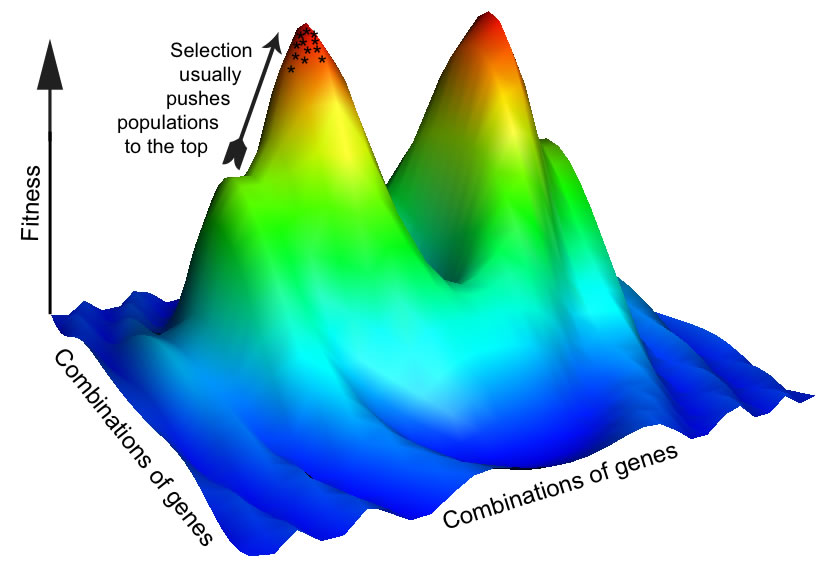
Doebeli’s work draws on pioneering ideas that geneticists like Sewall Wright developed in the early 1900s. Wright pictured evolution like a hilly landscape. Each point on the landscape represents a different combination of traits — the length of a lizard’s legs versus the width of its trunk, for example. A population of lizards might be located on a spot on the landscape that represents long legs and a narrow trunk. Another spot on the landscape would represent short legs and a narrow trunk. And in another direction, there’s a spot representing long legs and a thick trunk.

The precise combinations of traits in an organism will influence its success at reproducing. Wright used the elevation of a spot on the evolutionary landscape to record that success. An evolutionary landscape might have several peaks, each representing one of the best possible combinations. On such a landscape, natural selection always pushes populations up hills. Eventually, a population may reach the top of a hill; at that point, any change will lead to fewer offspring. In theory, the population should stay put.

The future of evolution might seem easy to predict on such a landscape. Scientists could simply look at the slope of the evolutionary landscape and draw a line up the nearest hill.

“This view is just simply wrong,” said Doebeli.

That’s because the population’s evolution changes the landscape. If a population of bacteria evolves to feed on a new kind of food, for example, then the competition for that food becomes fierce. The benefit of specializing on that food goes down, and the peak collapses. “It’s actually the worst place to be,” Doebeli said.

“Over short periods of time, it is predictable, if you have enough information. But you can’t predict it over long periods of time.”

To keep climbing uphill, the population has to veer onto a new course, toward a different peak. But as it travels in a new direction, it alters the landscape yet again.


- More from Carl Zimmer

Quote of the Day

Without ambition one starts nothing. Without work one finishes nothing. The prize will not be sent to you. You have to win it.

- Ralph Waldo Emerson

Tuesday, August 5, 2014

Google Glass Is Helping Save The Rhino

Naturalists are equipped with much more than baggy shorts and binoculars these days – they need the latest tech on side

“In fact, I am one of those chaps in baggy shorts with binoculars! I love nothing more than waking up in a place and hearing new birdsongs and going out and figuring out who’s singing. I love being in the field. That’s why I got into this business. But I also know that we are increasingly outgunned by the bad guys. The poachers have night-vision goggles, AK47s and helicopters and, unless we’re prepared bring in the same level of resources to stop what has become a massacre of elephants, tigers and rhinos, we’re not going to win. Technology is important for understanding where animals are, understanding where poachers are, tracking illegal goods, seeing where the food we eat comes from. We have a partnership with Google that looks to experiment with all kinds of different technologies to track animals – and also track poachers. We’ve experimented with Google Glass in Nepal for monitoring rhinos, using cell-phone technology and tracking poachers from the air so the law enforcement authorities can be in the right place to intercept them. We’re very much in the experimentation stage as it’s really important to have the best tech – but it also has to be practical and simple. If it breaks down, it has to be repairable in the most remote locations. Nepal has just declared its second year of no poaching, setting a standard for the rest of world, and a lot of that is down to technology and monitoring. We keep to the rule of law, we work closely with governments, but we’re not going to win if we’re too nice about it. When you get on the front lines and you see communities and governments that have the right resources and are fighting back, it makes your heart sing.”


- Interview with Carter Roberts the President and CEO of World Wildlife Fund